













Table of Contents
What is the most practical way to retrofit hydronic underfloor heating without tearing up floors and walls?
Wireless RF (Radio Frequency) thermostat technology eliminates the need for new cabling between thermostats and the wiring centre. Using 868MHz RF communication, battery-powered thermostats transmit heating demands wirelessly — making UFH retrofits viable in heritage buildings, period properties, and multi-story renovations where running cables is impractical or prohibited.
- Zero structural damage — no chasing cables into walls or floors
- Rapid installation — mount thermostats and pair wirelessly
- Scalable — up to 8 zones per hub, cascade to 64 zones
Introduction
Retrofitting hydronic underfloor heating into existing buildings presents a fundamental challenge: how to get control signals from the thermostat on the wall to the wiring centre at the manifold without tearing open floors and chasing cables into solid walls.
In new construction, the answer is straightforward — run the cables before the screed goes down. In retrofit projects — particularly heritage buildings, period properties, and multi-story renovations — the cost and disruption of new cabling often make the project unviable.
Wireless RF (Radio Frequency) thermostat technology provides an alternative. By eliminating the physical cable connection between thermostat and wiring centre, it enables UFH retrofits in buildings where running new wires is expensive, disruptive, or simply impossible.
This article examines how 868MHz RF wireless technology works in hydronic underfloor heating applications — a solution available in SASWELL's WHL Series hydronic thermostats — along with its reliability characteristics and the practical considerations for specifying wireless controls in retrofit projects.
Key insight: Wireless RF technology is not a luxury add-on for UFH retrofits — it is a practical solution to a fundamental problem. By eliminating the need for new cabling, it makes underfloor heating viable in buildings where wired systems cannot be deployed.
- 868MHz RF provides better building penetration than 2.4GHz Wi-Fi
- Battery-powered thermostats with 18–24 month battery life
- Zero structural damage — surface mount only
The Challenge: Cabling in Retrofits
Renovating an older property comes with its own set of challenges, particularly when upgrading to modern multi-zone underfloor heating. The biggest hurdle is wiring.
Tearing up walls and floors to run thermostat cables is costly, messy, and often impossible in heritage buildings. Solid masonry walls, concrete floors, and listed building restrictions mean that chasing cables is either structurally damaging or simply prohibited.
Traditional wired solutions require a cable from each thermostat location back to a central wiring centre. In a multi-zone system with six or eight thermostats, this means multiple cable runs through the building fabric — each representing a potential point of failure, each adding labour cost, each creating disruption.
How RF Wireless Technology Works
An RF wireless hydronic control system replaces the physical thermostat cable with a radio link.
The system consists of three main components:
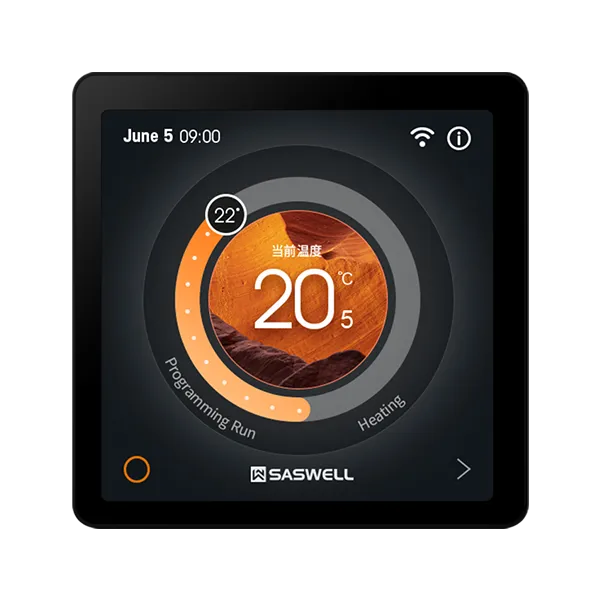
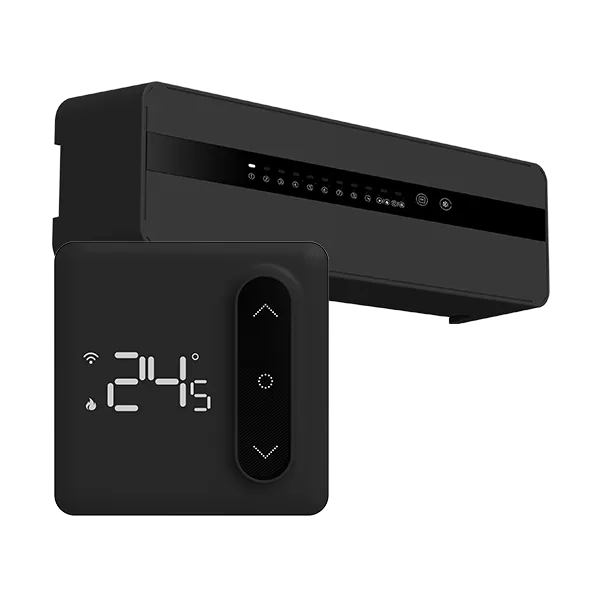
Wireless thermostats — Battery-powered room units that measure temperature and transmit heating/cooling demands via RF signal. No wiring to the thermostat location is required.
RF wiring centre — A central hub at the manifold that receives RF signals from all thermostats and controls the actuators for each zone.
868MHz RF protocol — The dedicated radio frequency band used for communication between thermostats and the wiring centre.
The thermostats communicate directly with the wiring centre via radio signal, removing the need for additional wiring between the two. Thermostats can be placed anywhere in the room, with no constraints imposed by cable routing.
The 868MHz frequency is specifically chosen for building automation applications. It offers several advantages over other wireless protocols: it is a dedicated band for short-range devices, it experiences less congestion than the 2.4GHz band used by Wi-Fi and Bluetooth, and it provides better penetration through building materials.
Key Benefits of RF Wireless for UFH Retrofits
Zero-invasive installation
The primary advantage of an RF wiring centre is the elimination of thermostat cables. By using 868MHz wireless technology, thermostats can be placed anywhere in the room, communicating directly with the central hub at the manifold. This makes it the ideal retrofit heating solution for homeowners who want modern comfort without a full-scale construction site.
No chasing cables into walls. No lifting floorboards. No making good afterwards.
Reliability that rivals hardwired systems
A common concern with wireless technology is signal stability. Professional-grade RF manifold controllers use high-frequency RF protocols designed specifically for HVAC applications:
- Extended Range: Strong enough to penetrate thick walls and multiple floors in traditional masonry buildings. Typical indoor range is 30 to 50 metres, sufficient for most large residential villas and heritage properties. In open air, range extends to 100 metres.
- Anti-Interference: Unlike Wi-Fi, which can become congested, dedicated 868MHz RF channels ensure heating commands are never missed.
Flexibility for evolving spaces
Retrofit projects often happen in stages. A wireless UFH control centre allows for modular expansion. Need to add a new heating zone in an attic conversion next year? Simply pair a new wireless thermostat to the existing hub in seconds. No new cables, no new holes in the wall.
Scalability for large projects
A single RF wiring centre supports up to 8 zones — sufficient for most residential retrofits. For larger projects such as hotel clusters, multi-building developments, or commercial portfolios, up to 8 wiring centres can be cascaded together, supporting up to 64 independent zones. This scalability is built into the SAS936BWCH wireless kit, which natively supports 8 zones per hub with cascade expansion capability. Slave units sync heat/cool mode with the master, and only the master controls boiler/heat pump output — ensuring seamless system-wide coordination without additional complexity.
Rapid deployment
Installation time is dramatically reduced. Thermostats are simply mounted on the wall and paired with the wiring centre. No cable runs to measure, cut, and terminate. No polarity to check. No continuity tests to perform.
Battery-powered convenience
RF thermostats are typically powered by standard AA batteries. Battery life of 18 to 24 months under normal use means minimal ongoing maintenance.
When to Specify Wireless RF
RF wireless is not the right solution for every project, but it is the preferred choice for specific scenarios:
| Project Type | RF Wireless Suitability |
|---|---|
| Heritage and listed buildings | Highly recommended — no structural damage |
| Multi-story renovations | Recommended — avoids multiple cable runs through floors |
| Period properties with solid walls | Recommended — chasing cables is impractical |
| New builds with easy cable access | Not necessary — wired solutions are more cost-effective |
| Large commercial installations | Consider with caution — range and interference need assessment |
For projects where wireless is not the right fit — such as dense multi-story buildings with thick concrete slabs — SASWELL's SAS931WCH wired BUS system provides a permanent, interference-free alternative. The 2-wire non-polarity BUS technology that underpins this system eliminates wiring errors at the hardware level, a key advantage explored in our dedicated technical overview.
Limitations and Considerations
While RF technology is highly reliable, it is not infallible. Building construction can affect signal strength:
- Thick concrete slabs and steel reinforcement can attenuate RF signals
- Multi-story layouts may require repeaters or strategic hub placement
- Other RF devices operating on similar frequencies can cause interference
Professional installers should verify signal strength during commissioning. Most systems include a signal test feature to confirm reliable communication before finalising the installation.
Battery life is another consideration. While 18–24 months is typical, high-traffic areas or frequent manual adjustments may reduce battery life. Specifying battery level indication on the thermostat display helps users plan replacements.
Comparison: Wired vs Wireless RF for UFH Retrofits
| Feature | Wired System | Wireless RF System |
|---|---|---|
| Cabling required | Yes — each thermostat to wiring centre | No — RF communication only |
| Installation time | Extended — cable routing through structure | Rapid — mount and pair |
| Structural impact | High — chasing cables into walls/floors | None — surface mount only |
| Heritage building suitability | Low — often prohibited | High — no structural changes |
| Signal reliability | 100% — physical connection | High — professional-grade RF |
| Battery maintenance | None | Replace every 18–24 months |
| System expansion | Requires new cable runs | Pair new thermostat wirelessly |
| Max capacity | Depends on third-party hubs | 8 zones per centre (cascade up to 64 zones) |
| Cost structure | Lower hardware, higher labour | Higher hardware, lower labour |
Technical Specifications
For installers and system designers requiring detailed technical information:
| Specification | Detail |
|---|---|
| Frequency band | 868MHz (EU) / 433MHz (selectable) |
| RF range (open air) | Up to 100m |
| RF range (indoor typical) | 30–50m |
| Thermostat power | 2 × 1.5V AA batteries |
| Battery life | 18–24 months typical |
| Max zones per wiring centre | 8 |
| Cascade support | Up to 8 wiring centres (64 zones total) |
| Communication | 2-way RF with signal verification |
Conclusion
Wireless RF thermostat technology is not a luxury add-on for hydronic underfloor heating retrofits — it is a practical solution to a fundamental problem. By eliminating the need for new cabling, it makes UFH retrofits viable in buildings where wired systems cannot be deployed.
For installers, it means faster installation with zero structural damage. For developers, it means heritage and constrained buildings can be upgraded to modern heating standards. For homeowners, it means modern comfort without the disruption of a full-scale renovation.
By choosing an 868MHz RF wireless heating control system, you provide a fast, clean, and high-tech upgrade that meets the demands of today's renovation market. For a complete system-level view — from wireless thermostat deployment to wiring centre integration and zone-by-zone scheduling — explore the Smart Multi-Zone Hydronic Control Solution.