FEATURED SNIPPET OPTIMIZED — QUICK ANSWER
How does HDC218-VAV comply with ISO 14644 for cleanroom VAV control?
The HDC218‑VAV decoupled BACnet controller features CAV constant air volume mode, 0.1 Pa high-precision differential pressure sensor, airflow threshold alarm and pressure-independent PI control. It stably maintains positive pressure, fixed air change rates and filter monitoring, fully meeting ISO 14644 standards for pharmaceutical, electronics and semiconductor cleanrooms.
Additional Featured Snippet insight: Core differences between cleanroom and lab control
Cleanrooms require stable positive pressure and constant airflow to block external contamination, while laboratories adopt negative pressure for personnel protection. Choose matched control logic and actuator configuration according to on-site working conditions.
In pharmaceutical, electronics, and semiconductor manufacturing, cleanroom (dust‑free workshop) environmental control directly impacts product quality and production safety. Unlike comfort HVAC or laboratories (which typically maintain negative pressure), cleanrooms require constant air change rates, stable positive pressure gradients, and efficient filter monitoring. Traditional VAV controllers often focus only on temperature, ignoring pressure and cleanliness—the two most critical parameters. This article explains how the HDC218‑VAV decoupled controller meets the strict requirements of ISO 14644 for cleanroom applications. If you are new to VAV controller selection, start with our VAV controller selection guide (hub page).
1. Cleanroom vs Laboratory: Fundamental Control Differences
|
Environment
|
Pressure direction
|
Primary goal
|
Key parameters
|
Actuator requirement
|
|
Laboratory
|
Negative (contain contaminants)
|
Personnel safety
|
-15 Pa, air change rate
|
Spring‑return (close on power loss)
|
|
Cleanroom
|
Positive (keep external contamination out)
|
Product safety
|
+10 to +30 Pa, constant airflow, filter differential pressure
|
Spring‑return optional (depends on process)
|
In cleanrooms, positive pressure is essential. Supply airflow must exceed exhaust, and the supply air volume cannot be arbitrarily reduced during load changes – otherwise cleanliness may be compromised.
2. Key ISO 14644 Requirements for VAV Control
ISO 14644‑1 defines cleanroom classes (ISO 5 to ISO 9) and sets requirements for air change rates, particle concentration, and pressure differentials. Relevant clauses for VAV control include:
-
Air change rate: e.g., ISO Class 7 (Class 10,000) typically requires 15‑60 air changes per hour. The VAV controller must maintain constant volume regardless of duct pressure fluctuations – easily achieved with the HDC218‑VAV's constant volume (CAV) mode.
-
Pressure differential: Adjacent cleanrooms must maintain a positive pressure difference of 5‑20 Pa. The controller needs a DP sensor with 0.1 Pa resolution and alarm output capability.
-
Filter monitoring: When HEPA/ULPA filters become clogged and airflow drops, the system should trigger an alarm. The controller must support adjustable airflow thresholds.
3. How HDC218‑VAV Meets Cleanroom Demands
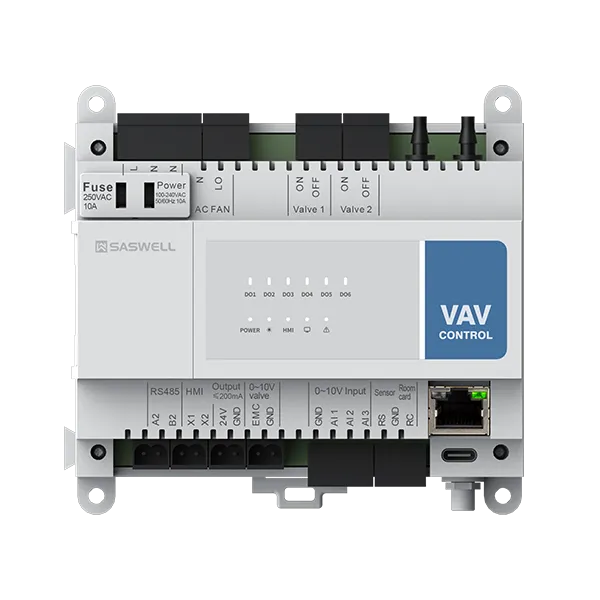
The HDC218‑VAV is a decoupled BACnet controller purpose‑built for critical environments. It offers:
3.1 Constant Air Volume (CAV) Mode
One‑touch switching to CAV mode locks the damper position, delivering stable airflow independent of duct pressure fluctuations – perfect for meeting ISO 14644 air change rate stability requirements.
3.2 Built‑in High‑Precision DP Sensor
Range ±500 Pa, resolution 0.1 Pa. Reads room‑to‑corridor pressure directly – no external transmitter needed, reducing failure points.
3.3 Airflow Threshold Alarm
Set min/max airflow limits. When a filter clogs and airflow drops below the threshold, the controller outputs an alarm (via DO or BACnet). This enables timely filter replacement, preventing production loss.
3.4 Pressure‑Independent PI Control
Maintains setpoint pressure or airflow even under duct pressure fluctuations, eliminating system hunting. For an in‑depth look at hunting causes and solutions, read our VAV system hunting fix guide.
3.5 Spring‑Return Actuator Support
For processes that require fail‑safe protection, the controller can drive spring‑return actuators to close (or open) the damper on power loss, maintaining positive pressure or preventing backflow. For detailed actuator selection parameters, see our 0-10V damper actuator selection guide.
4. Typical Applications
-
Pharmaceutical cleanrooms: Maintain positive pressure gradients between Grade A/B/C/D areas; monitor filter resistance.
-
Electronics fabs (semiconductor/panel): Control constant supply airflow in ISO Class 1000/10000 zones to ensure microenvironment stability.
-
Medical device manufacturing: Integrate with our Lab & Cleanroom VAV Safety System for centralized monitoring. For comfort applications (offices, hotels), refer to our Commercial Building VAV Energy Solution.
5. Selection and Commissioning Tips
-
Actuator selection: Torque 8‑16 N·m (depending on damper size), running time 5‑15 seconds for fast pressure response. Spring‑return recommended. See our 0-10V damper actuator selection guide (includes matching tips for HDC218‑VAV).
-
Pressure sampling tubing: One silicone tube connects the room and corridor, attached directly to the controller’s high‑pressure and low‑pressure ports.
-
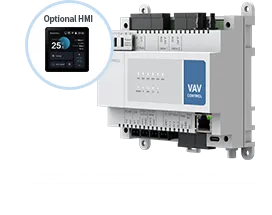
Airflow calibration: Use the optional SAS965‑HMI or a BMS; follow our VAV commissioning checklist.
-
Alarm output: Connect the DO signal to a strobe horn or BMS to alert personnel when a filter clogs.
6. Conclusion
Cleanroom VAV control cannot simply copy designs from comfort HVAC or laboratories. A controller that offers constant volume mode, high‑resolution DP sensing, and airflow threshold alarms is essential for stable, compliant cleanroom operation. With its pressure‑independent design, 0.1 Pa resolution, and open BACnet protocol, the HDC218‑VAV provides a reliable, regulation‑ready solution for pharmaceutical, electronics, and other high‑stakes industries. For project‑specific support, feel free to contact us.
People Also Ask (Cleanroom VAV & ISO 14644)
Quick answers to common questions about cleanroom VAV control and ISO 14644 compliance.
Frequently Asked Questions (FAQ)
What is the main difference between cleanroom and lab pressure control?
Cleanrooms maintain positive pressure (10~30 Pa) to block external contaminants and protect products. Laboratories run negative pressure to contain hazardous substances and ensure personnel safety.
What core ISO 14644 rules apply to cleanroom VAV systems?
ISO 14644 regulates air change rates, particle concentration and pressure differentials. The system must keep stable constant airflow, 5~20 Pa positive pressure between adjacent rooms and effective filter clogging alarm.
Why is constant airflow required for cleanrooms?
Arbitrary airflow reduction will break positive pressure balance and introduce dust particles. Constant air volume ensures stable air change rate and long-term cleanliness, complying with production standards.
What are the key features of HDC218-VAV for cleanroom use?
It supports CAV constant volume mode, built-in 0.1 Pa high-precision differential pressure sensor, airflow threshold alarm and pressure-independent PI control, fully adapting to strict cleanroom operating conditions.
What actuator parameters are recommended for cleanroom VAV?
Select actuators with 8‑16 N·m torque and 5‑15 seconds running time for fast pressure response. Spring‑return type is recommended for fail‑safe protection according to production requirements.
Learn More About HDC218-VAV VAV Controller
Contact our team for cleanroom VAV project solution, parameter matching and technical support.
Explore full portfolio → VAV Controller Series


 Commercial HVACWe provide a one-stop terminal control product package, including thermostats, motorized valves and actuators, and environmental sensors, meeting the multiple requirements for precise control, stable operation, and integration with mainstream BMS systems in building scenarios.
 NRC/BuilderWe provide top-tier HVAC system control solutions for fine decoration real estate projects, meeting both the aesthetic match of fine décor and intelligent linkage with other systems.
 Large-Scale DIY Retail & E-CommerceAs a leading brand in TRV (Thermostatic Radiator Valve) control technology, we provide mature HVAC control product kits for supermarket and e-commerce channels, helping channels quickly achieve scaled sales.
 Energy-Saving RetrofitLeveraging professional system integration with wireless technology, we support various public spaces like offices, hotels, and shopping malls to implement energy-efficient solutions, achieving intelligent lighting, air conditioning, and facility management.
 Pro Home ImprovementAs a leading supplier in the HVAC automatic control field, we provide residential HVAC control systems with localized implementation capabilities for the home decoration retail market, balancing installation delivery and user experience.
 Global Partner for Innovation and Reliability in HVAC CONTROLSSASWELL has always been our core goal to serve as a solid backing for customers in consolidating their leading position in the market, while providing Fast-customized solutions to high-quality customers worldwide.Learn More