












Table of Contents
How can you deliver whole-home App-based heating control without installing WiFi thermostats in every room?
Single-Master WiFi architecture uses one WiFi-enabled Master thermostat as the gateway for the entire system. Slave thermostats communicate via a low-voltage BUS network (2-wire non-polarity cable or wireless RF) — eliminating the need for WiFi modules in every zone while delivering the same unified App experience.
- One WiFi connection — not one per zone
- Simplified commissioning — single network configuration
- Reduced hardware cost and network congestion
Introduction
App-based temperature control has become a standard expectation in modern residential heating. Homeowners want to adjust room temperatures from their phones, schedule heating around their daily routines, and monitor energy usage remotely.
The conventional approach to delivering this capability is straightforward: install a WiFi-enabled thermostat in every room that needs individual control. In a four-zone system, that means four WiFi thermostats. In an eight-zone system, eight WiFi thermostats.
This approach works, but it carries significant costs — both financial and operational. Each WiFi thermostat adds hardware expense, each one requires network configuration, and each one increases the complexity of commissioning and ongoing support.
There is an alternative: Single-Master WiFi architecture. This design delivers whole-building App connectivity through a single WiFi-enabled Master thermostat, with slave thermostats communicating through a low-voltage BUS network. The result is the same App experience at a fraction of the network complexity — an architecture already deployed across SASWELL's WHL Series hydronic thermostats.
Key insight: Single-Master WiFi architecture delivers the same App experience as a full-WiFi system — with one WiFi module instead of eight. The result is lower hardware cost, simpler commissioning, and reduced network congestion.
- One WiFi connection for the entire building
- Slave thermostats communicate via BUS or RF
- Simplified troubleshooting and maintenance
What Is Single-Master WiFi Architecture?
Single-Master WiFi architecture is a distributed control topology where one thermostat serves as the WiFi gateway for the entire system.
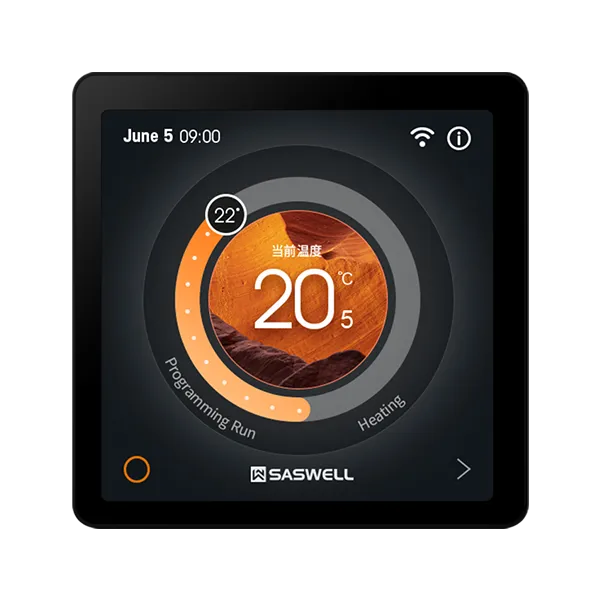
The Master is a WiFi-enabled thermostat that connects to the home network and the cloud App platform. It receives commands from the App, processes scheduling logic, and communicates mode changes to the rest of the system.
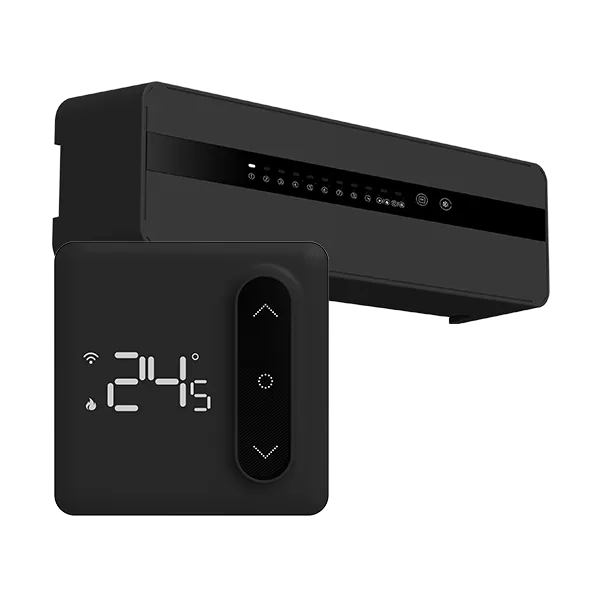
The Slaves are thermostats that do not have their own WiFi modules. Instead, they communicate with the Master and the wiring centre via a low-voltage BUS network — either a 2-wire non-polarity cable or a wireless RF link. They measure room temperature, receive setpoint adjustments from the user interface, and send heating/cooling requests to the wiring centre for their respective zones.
The wiring centre acts as the system hub, receiving commands from the Master and passing them to the appropriate zones, while also collecting status data from the slaves.
One WiFi connection serves the entire building — regardless of how many zones are installed.
The Conventional Approach: WiFi Thermostats in Every Room
To understand the value of Single-Master architecture, it helps to examine the conventional alternative.
In a typical multi-zone WiFi system, each room has its own WiFi-enabled thermostat. Each thermostat connects independently to the home network and the cloud platform. Each one requires:
- Individual network configuration and credential entry
- Separate pairing to the App
- Individual firmware updates
- Independent troubleshooting when connectivity issues arise
The challenges multiply as the zone count increases:
| Challenge | 4-Zone System | 8-Zone System |
|---|---|---|
| WiFi thermostats required | 4 | 8 |
| Network configuration points | 4 | 8 |
| Potential connectivity failure points | 4 | 8 |
In large residential projects with six or eight zones, the hardware investment alone becomes substantial — and the commissioning time can extend significantly as each thermostat is individually configured.
How Single-Master WiFi Architecture Works
The Single-Master approach fundamentally changes this dynamic.
One connection. The Master thermostat is the only device that requires WiFi configuration. It connects to the 2.4GHz home network once, and the App pairing is performed once.
Distributed intelligence. Slave thermostats do not need WiFi modules. They communicate with the wiring centre via a low-voltage BUS network. In the wired configuration (SAS931WCH), this is a 2-wire non-polarity cable that carries both power and data. In the wireless configuration (SAS936BWCH), this is an RF link that eliminates cabling entirely.
Automatic synchronization. When the Master receives a heating/cooling mode change command from the heat pump or the App, it propagates this instruction to all slave thermostats through the BUS network automatically. No manual per-zone adjustment is required.
The wiring centre coordinates the distribution of commands to the appropriate zone actuators and collects status feedback from each slave thermostat.
The Costs of Traditional WiFi Approaches
The conventional "WiFi in every room" model creates several hidden costs beyond the obvious hardware expense.
Hardware cost. Each WiFi thermostat contains a WiFi module, antenna, and associated electronics. These components add cost to every unit. In an eight-zone system, the hardware premium for eight WiFi modules is substantial.
Network configuration load. Every WiFi thermostat must be individually connected to the home network. In a typical installation, this means entering WiFi credentials on each device, waiting for each to connect, and verifying each connection. For eight zones, this process repeats eight times.
Network congestion. Multiple WiFi devices on the same network increase congestion and can degrade performance for other connected devices. In homes with many smart devices, this becomes a meaningful concern.
Commissioning complexity. Each thermostat must be paired to the App individually. Troubleshooting connectivity issues becomes more complex when there are multiple potential failure points.
Ongoing maintenance. Firmware updates must be applied to each thermostat individually. If a WiFi module fails on one thermostat, that zone loses App connectivity even if the rest of the system is functioning correctly.
Benefits of Single-Master WiFi Architecture
Optimized cost structure. One WiFi module per system, not per zone. While the kit hardware includes multiple components, the centralized architecture reduces per-zone WiFi module duplication, simplifies network configuration, and lowers installation labor — offering total cost of ownership benefits that scale with zone count.
Simplified commissioning. One WiFi configuration. One App pairing. One point of network troubleshooting. Commissioning time is dramatically reduced compared to multi-WiFi systems.
Lower network load. One WiFi device on the home network, regardless of zone count. This reduces network congestion and preserves bandwidth for other smart home devices.
Easier troubleshooting. Connectivity issues are isolated to one device. If the Master loses connection, the problem is immediately identifiable. Slave thermostats continue to operate locally even if the Master WiFi connection is temporarily unavailable.
Consistent user experience. The App interface is identical whether the system has two zones or eight zones. The user interacts with one unified interface, not multiple devices.
Flexible deployment. Single-Master architecture supports both wired and wireless slave connections. New construction projects can use the wired BUS option for maximum reliability — the 2-wire non-polarity BUS technology that eliminates wiring errors at the hardware level. Retrofit projects can use the wireless RF option for zero structural damage, a solution detailed in our guide to RF wireless technology for retrofit applications.
Comparison: Single-Master vs. Full-WiFi Architecture
| Feature | Single-Master WiFi Architecture | Full-WiFi (Thermostat per Zone) |
|---|---|---|
| WiFi thermostats required | 1 (Master only) | 1 per zone |
| Network configuration points | 1 | 1 per zone |
| Hardware cost structure | Concentrated in one system kit | Distributed across individual units |
| Installation & commissioning labor | Lower — one network configuration | Higher — per-device configuration |
| Network congestion | Minimal | Increases with zone count |
| App experience | Unified per building | Unified per building |
| Troubleshooting complexity | Low | Increases with zone count |
| Best application | Multi-zone residential (4–8 zones) | Small systems (1–3 zones) |
Practical Considerations for Installers
Master thermostat placement. The Master thermostat should be installed in a central location with good router signal strength. This ensures reliable WiFi connectivity and optimal App response times.
Slave thermostat configuration. Slave thermostats do not require WiFi configuration. They communicate with the wiring centre automatically once powered and paired. The installation process is identical regardless of zone count.
Wiring centre setup. The wiring centre coordinates communication between the Master and all slaves. In the wired configuration, the 2-wire non-polarity BUS eliminates wiring errors and reduces installation time — a key advantage explored in our technical overview of BUS wiring. In the wireless configuration, the RF link eliminates cabling entirely.
System expansion. Adding new zones is straightforward. A new slave thermostat can be paired to the existing wiring centre without additional WiFi configuration. The Master already handles the network connection for the entire system.
Technical Specifications
| Specification | Detail |
|---|---|
| WiFi thermostat required | 1 (Master only) |
| Max zones per system | 8 (wired) / 8 per centre, cascade to 64 (wireless) |
| Slave communication | 2-wire non-polarity BUS (wired) / 868MHz RF (wireless) |
| Master WiFi band | 2.4GHz |
| App platform | Tuya / Smart Life |
| Network configuration | Single point (Master only) |
| Slave power | BUS-powered (wired) / AA batteries (wireless) |
Conclusion
Single-Master WiFi architecture solves a fundamental problem in multi-zone hydronic heating: how to deliver whole-building App control without the cost and complexity of WiFi thermostats in every room.
By centralizing connectivity in one Master thermostat and distributing control intelligence through a low-voltage BUS network, this architecture delivers the same user experience with dramatically simplified commissioning and ongoing maintenance.
For developers, it means smart home capability with simplified installation logistics. For installers, it means faster commissioning and fewer support calls. For homeowners, it means reliable App control without the complexity of managing multiple connected devices.
The design is simple: one connection for the whole building, regardless of how many zones you need to control. For a complete system-level view — from Master/Slave deployment to wiring centre integration and zone-by-zone scheduling — explore the Smart Multi-Zone Hydronic Control Solution.