












Table of Contents
Should you choose standalone thermostats or a system kit for your hydronic underfloor heating project?
The choice depends on zone count, project type, and control requirements. For 1-3 zones, standalone thermostats offer flexibility and lower upfront cost. For 4+ zones, system kits deliver unified App control, simplified installation, and lower total cost of ownership through reduced labour and automatic synchronization.
- 1-3 zones → Standalone thermostats
- 4+ zones → System kits with Single-Master WiFi
- Consider total cost: hardware + labour + commissioning
Introduction
When specifying hydronic underfloor heating controls for a residential or light commercial project, one of the first decisions you will face is this: should you specify individual standalone thermostats for each room, or deploy a complete multi-zone system kit?
The answer depends on several factors: the number of zones, the type of project (new build or retrofit), the control requirements (basic temperature regulation or App-based smart control), and the budget structure (hardware cost vs. installation labour).
This guide breaks down the two options, their respective strengths and limitations, and provides a practical decision framework for selecting the right control architecture for your project.
Key insight: The choice between standalone thermostats and system kits is not about which is "better" — it is about which is the right fit for your specific project. Standalone thermostats offer flexibility for small systems; system kits deliver integration and scalability for larger projects.
- Standalone: 1-3 zones, flexible sourcing, lower upfront cost
- System Kits: 4+ zones, unified App control, lower total cost of ownership
Two Product Categories, Two Different Purposes
The WHL Series offers two distinct product categories, each designed for different project types and control requirements.
Standalone Thermostats are individual units for single-zone or multi-zone control using standard wiring. The WHL Series includes six standalone models — SAS816WHL, SAS920WHL, SAS921WHL, SAS922WHL, SAS961WHL, and SAS965WHL — each designed for different project requirements, from basic rotary dial to full-colour touchscreen with UI customization.
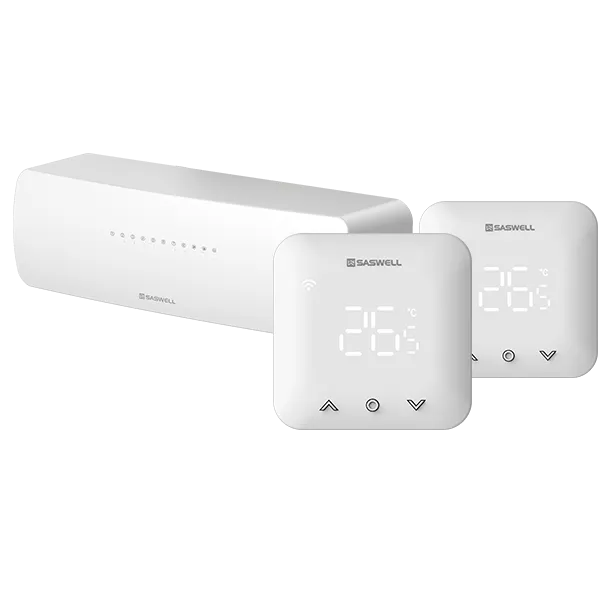
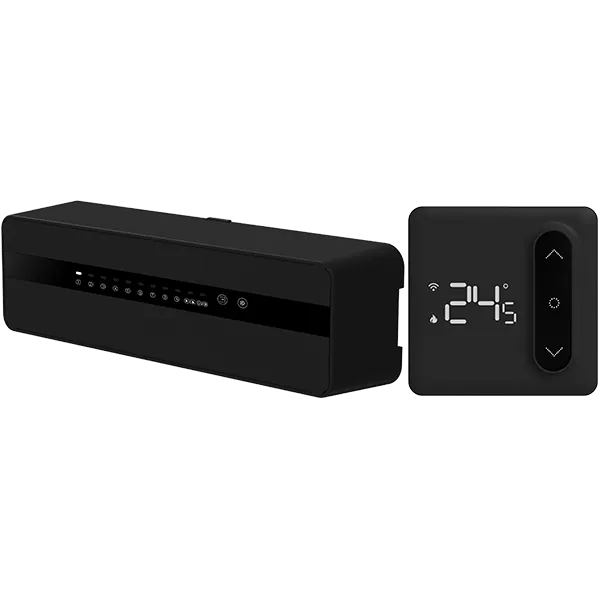
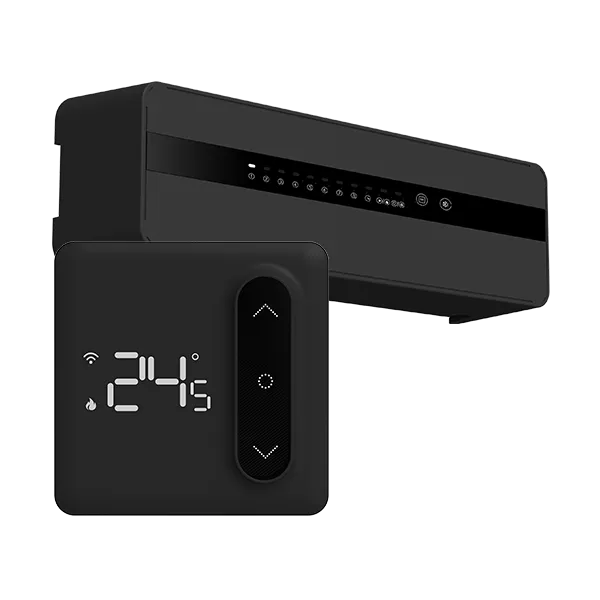
System Kits are complete closed-ecosystem solutions for multi-zone projects. The SAS931WCH (wired 12V bus) and SAS936BWCH (wireless RF) include a central wiring hub and room panels that communicate via proprietary protocols. These must be deployed as complete kits and are not interoperable with third-party wiring centres.
Standalone Thermostats: Flexibility and Simplicity
Standalone thermostats are independent units that control a single heating zone each. They connect to the wiring centre or directly to the actuator using standard low-voltage wiring.
Key advantages:
Sourcing flexibility. Standalone thermostats can be mixed with third-party wiring centres and actuators, giving you freedom to source components from multiple suppliers.
Lower hardware cost per zone. For small systems (1-3 zones), the upfront hardware investment is lower than purchasing a system kit.
Simplicity. Installation is straightforward: mount the thermostat, connect the wires, and configure the settings. No proprietary protocols or closed-ecosystem constraints.
Wide model selection. Six different models allow you to match the thermostat interface to the project requirements — from basic rotary dial to full-colour touchscreen with UI customization. View the full standalone thermostat lineup →
Limitations to consider:
Limited scalability. Each thermostat requires its own wiring back to the wiring centre. In a six-zone system, that means six separate cable runs through the building fabric.
No integrated App control. Most standalone models offer WiFi connectivity as an option, but each thermostat must be configured individually. There is no single-master architecture that provides whole-building unified App access.
Higher installation labour for large systems. The labour cost scales with the number of zones. More zones mean more cable runs, more terminations, and more commissioning time.
System Kits: Integration and Scalability
System kits are complete closed-ecosystem solutions that include a central wiring hub and all room panels, designed to work together as a single integrated system.
Key advantages:
Single-Master WiFi architecture. One WiFi-enabled Master thermostat provides whole-building App connectivity. Slave thermostats communicate via the BUS network and do not require their own WiFi modules — reducing network complexity and installation labor.
Simplified installation. In the wired configuration (SAS931WCH), a 2-wire non-polarity BUS eliminates wiring errors and reduces installation time. In the wireless configuration (SAS936BWCH), RF communication eliminates cabling entirely.
Scalability. A single system kit supports up to 8 zones natively, with cascade expansion up to 64 zones for larger projects.
Automatic synchronization. Heating/cooling mode changes propagate automatically across all zones from the Master thermostat or directly from the heat pump — no manual per-zone adjustment required.
Limitations to consider:
Closed ecosystem. System kits must be deployed as complete solutions and are not interoperable with third-party wiring centres. Individual components are not sold separately.
Higher upfront hardware cost. The initial investment for a system kit is higher than purchasing standalone thermostats for a small system.
Less flexibility in component sourcing. You cannot mix and match components from different suppliers — the entire system must come from a single source.
Decision Framework: Which One Should You Choose?
| Decision Factor | Standalone Thermostats | System Kits |
|---|---|---|
| Number of zones | 1-3 zones | 4+ zones |
| Project type | Small residential, single-room upgrades | Whole-house multi-zone, new builds |
| App control | Optional per-device | Unified whole-building |
| Installation labour | Higher for large systems | Lower (2-wire BUS or wireless) |
| Hardware cost | Lower for small systems | Higher upfront, lower per-zone for large systems |
| Component sourcing | Flexible — mix with third-party | Closed ecosystem — must use complete kit |
| Best application | Single rooms, small apartments, budget-sensitive projects | Multi-zone homes, large developments, smart home projects |
When to Choose Standalone Thermostats
Standalone thermostats are the right choice when:
- Your project has 1 to 3 zones
- You are upgrading a single room or a small apartment
- Budget is the primary constraint
- You already have a wiring centre and actuators in place
- You do not require whole-building App control
- You need sourcing flexibility across multiple suppliers
For these scenarios, standalone thermostats deliver the core functionality of temperature control at the lowest possible hardware cost, with the flexibility to mix and match components as needed.
When to Choose System Kits
System kits are the right choice when:
- Your project has 4 or more zones
- You are building a new home or undertaking a whole-house renovation
- Whole-building App control is a requirement
- You want to minimize on-site installation labour
- You value system-wide integration and automatic synchronization
- You are specifying for a large development or multi-building project
For these scenarios, system kits deliver lower total cost of ownership through reduced installation labour, simplified commissioning, and unified control across all zones.
Cost Consideration: Hardware vs. Labour
The cost equation for standalone thermostats vs. system kits is not simply about the price of the hardware. The total cost of ownership includes installation labour, commissioning time, and ongoing maintenance.
Standalone thermostats. Lower hardware cost per zone, but higher installation labour for large systems. Each thermostat requires individual wiring, configuration, and testing. The total cost advantage diminishes as the zone count increases.
System kits. Higher upfront hardware cost, but lower installation labour. The 2-wire BUS or wireless RF architecture reduces cabling and termination time. Commissioning is faster due to automatic synchronization and single-point WiFi configuration.
For a 1-3 zone system, standalone thermostats are usually more cost-effective. For a 4-8 zone system, the labour savings of a system kit often outweigh the higher hardware cost, resulting in lower total cost of ownership.
Practical Considerations for Installers
Standalone thermostat installation. Each thermostat requires its own cable run back to the wiring centre. Polarity must be checked. Each thermostat must be configured individually. Commissioning time increases with each additional zone.
System kit installation. The 2-wire non-polarity BUS eliminates wiring errors and reduces installation time. In the wireless configuration, no cabling is required at all. One WiFi configuration for the entire system. Commissioning time is minimal regardless of zone count.
Conclusion
The choice between standalone thermostats and system kits is not about which is "better" — it is about which is the right fit for your specific project.
Standalone thermostats offer flexibility, simplicity, and lower upfront cost for small systems. They are the practical choice for single-room upgrades, small apartments, and budget-sensitive projects.
System kits offer integration, scalability, and lower total cost of ownership for larger systems. They are the strategic choice for whole-house multi-zone projects, new builds, and developments where unified App control and installation efficiency are priorities.
Understand your project requirements, evaluate the trade-offs, and choose the architecture that aligns with your goals. For a complete system-level view of system kit deployment — from wiring centre integration to zone-by-zone scheduling — explore the Smart Multi-Zone Hydronic Control Solution.